Canada 150 is a celebration of Indigenous genocide
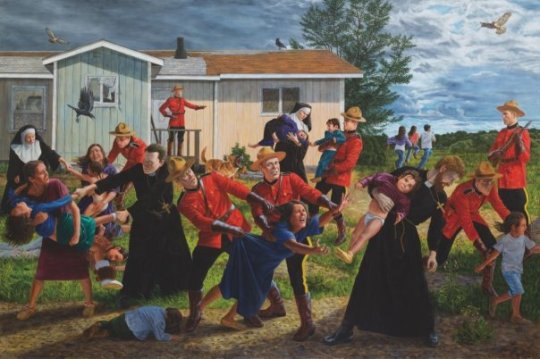
The Scream, on the cover, The Subjugation of Truth, by Kent Monkman.
by Pamela Palmater, Now Toronto, March 29, 2017
For many Indigenous peoples on Turtle Island (North
America), it’s difficult to imagine Prime Minister Justin Trudeau – who
has said that “no relationship is more important to Canada than the one
with Indigenous peoples”- celebrating the last 150 years of brutal
colonization and the foundation of what is now known as Canada.
This year, the federal government plans to spend half a billion
dollars on events marking Canada’s 150th anniversary. Meanwhile,
essential social services for First Nations people to alleviate
crisis-level socio-economic conditions go chronically underfunded. Not
only is Canada refusing to share the bounty of its own piracy; it’s
using that same bounty to celebrate its good fortune. Arguably, every
firework, hot dog and piece of birthday cake in Canada’s 150th
celebration will be paid for by the genocide of Indigenous peoples and
cultures.
Many places are struggling with the nation’s genocidal origins.
In Halifax, the school board voted to change the name of Cornwallis
Junior High because its namesake, Edward Cornwallis, was responsible for
putting bounties on the scalps of Mi’kmaw people, causing many deaths.
Likewise, in Toronto, Ryerson University has come under scrutiny for
its namesake, Egerton Ryerson, a strong supporter of residential
schools, where thousands of Indigenous children died violent, torturous
deaths.
Even the “Famous Five” women long celebrated as champions of women’s
rights have had their hero status questioned because of their support
for sterilization of Indigenous women. Celebrating genocide is not what
most would consider a modern Canadian value.
While use of the term “genocide” to describe Canada’s treatment of
Indigenous peoples has created a great deal of debate, there has always
been a recognition that, at minimum, Canada was guilty of “cultural
genocide,” even if individuals couldn’t bring themselves to accept more
sinister intentions.
Former prime minister Paul Martin told the Truth and Reconciliation
Commission (TRC) that it was time to call the residential schools policy
what it was: “cultural genocide.”
Supreme Court of Canada Chief Justice Beverley McLachlin weighed in
on Canada’s dismal human rights record, saying that residential schools
were attempts to commit “cultural genocide” against Indigenous peoples.
While these comments were made before the TRC report was tabled in
late 2015, they did raise questions in the public sphere about how to
recognize genocide when it’s not part of something like the Holocaust or
the war in Rwanda.
Despite the sensitive nature of making the claim of genocide, the TRC
went further after investigating the historical record, stating that
the totality of policies toward Indigenous peoples amounted to cultural,
biological and physical genocide.
The difficult part about public discourse related to genocide is that the majority of Canadians don’t have all the facts.
Most mistakenly believe genocide only occurs when millions of people
are killed in concentration camps. They’re not taught in school about
the real history of the atrocities committed against Indigenous peoples
that over time resulted in millions dying. Some universities teach
genocide studies without any mention of the lethal colonization process
in Canada.
The real history, however, shows that even after signing peace
treaties with First Nations, laws were enacted in Canada offering
bounties for scalps of Indigenous men, women and children. The treaty
negotiation process itself was conducted under conditions of starvation
or threats of violence. While some argue that these acts were committed
pre-Confederation, it must be kept in mind that they are in fact how
Canada became Canada.
“Indian policy” was based on acquiring Indigenous lands and resources
and reducing financial obligations to Indigenous peoples. The primary
methodology was either assimilation or elimination. These acts included
confining Indigenous peoples to tiny reserves and forbidding them to
hunt, fish or provide for their families, forcing them to live on
unhealthy and insufficient rations that caused ill health and
starvation.
It didn’t stop there. Other genocidal acts included the forced
sterilization of Indigenous women and little girls and the mass theft
from families of Indigenous children, many of whom were physically and
sexually assaulted, experimented on, tortured and starved at residential
schools – leading to the deaths of thousands.
This is how Canada cleared the land for farms, mining, oil extraction
and development. It simply would not be the wealthy country it is, one
of the best countries in the world to live and raise a family, were it
not for the removal of Indigenous peoples from the source of Canada’s
wealth.
The real crime, however, is not only Canada’s failure to take steps to right the wrongs of the past.
Today, more Indigenous children are taken from their families – now
put into foster care – than at the height of the residential schools
cruelty. The over-incarceration of Indigenous men, women and children
continues at alarming rates. Even though Indigenous people represent
only 4 per cent of the population, some prisons contain nearly 100 per
cent Indigenous inmates.
The federal government and law enforcement agencies have allowed the
crisis of murdered and missing Indigenous women and girls to continue
with little intervention – suggesting complicity in the deaths.
The prime minister spoke at National Aboriginal Day ceremonies in
2016 about “the importance of reconciliation and the process of
truth-telling” in healing Canada’s relationship with Indigenous peoples.
He has no right to speak about reconciliation before he takes the
necessary steps to make amends. Canada has no right to ask any one of us
to talk about moving forward until the prime minister and all premiers
take responsibility for what their institutions have done – and continue
to do – to Indigenous peoples. No amount of token showcasing of
Indigenous art, songs or dances in Canada’s 150th celebration will stop
the intergenerational pain and suffering, suicides, police abuse,
sub-standard health care, housing and water, or the extinction of the
majority of Indigenous languages.
Perhaps Canada should humble itself, step back, cancel its plans and
undertake the hard work necessary to make amends for its legacy. Then we
could all celebrate the original treaty vision of mutual respect,
prosperity and protection envisioned by our ancestors. Until then, I’ll
pass on the cake.
Pamela Palmater is a Mi’kmaw citizen member of Eel River Bar
First Nation. She has been practising Indigenous law for 18 years and is
currently an associate professor and the Chair in Indigenous Governance
at Ryerson University.
How the United Nations defines genocide
According to the United Nations Convention on the Prevention and
Punishment of the Crime of Genocide, genocide is defined in Article II
as acts “committed with the intent to destroy, in whole or in part, a
national, ethnical, racial or religious group.” Described by the UN as
an “odious scourge” (repulsive evil causing great suffering), genocide
can be committed in any one of following ways: killing members of the
group; causing serious bodily or mental harm; inflicting conditions of
life meant to bring about their destruction; preventing births within
the groups; and/or forcibly transferring the children of the group to
another group.